
- Marie-Eve Desrosiers
- Nic Cheeseman
- Des dirigeants politiques comme le Premier ministre canadien Mark Carney ont exhorté les « puissances moyennes » mondiales à s’unir pour défendre la démocratie et l’ordre libéral fondé sur des règles. Bien que louables, ces appels reposent sur une conception dépassée des puissances moyennes comme des acteurs démocratiques largement bienveillants engagés à fournir des biens publics mondiaux. En réalité, de nombreuses puissances moyennes sont autoritaires et sont plus susceptibles de contribuer à l’érosion des normes et institutions mondiales qu’aux efforts pour les maintenir. S’appuyant sur des preuves issues de cas tels que les Émirats arabes unis, l’Arabie saoudite et la Turquie, cet essai présente un nouveau cadre pour comprendre comment les puissances intermédiaires autoritaires utilisent des alliances avec leurs homologues démocratiques pour se couvrir tout en sapant simultanément les institutions multilatérales libérales, en promouvant des idéaux autocratiques et en pratiquant la répression transfrontalière. Ces pratiques méritent une plus grande attention car elles servent à diluer les engagements mondiaux en matière de droits de l’homme, à normaliser la gouvernance autoritaire et à accélérer le démantèlement de l’ordre international fondé sur des règles.
-
Lavague mondiale actuelle d’autocratisation pose l’un des tests les plus sérieux à l’architecture mondiale longtemps considérée comme structurant la politique internationale : l’ordre international libéral fondé sur des règles qui, depuis 1945, a aidé à coordonner la coopération sur tout, du commerce au climat en passant par la sécurité. Les inquiétudes concernant l’érosion — et l’effondrement potentiel — de ce cadre se sont intensifiées ces dernières années en réponse à la conduite de plus en plus unilatérale et coercitive des États puissants. Des actions telles que l’invasion non provoquée de l’Ukraine par la Russie, les menaces publiques du président américain Donald Trump d’affirmer le contrôle du Groenland, ainsi que l’usage croissant par la Chine de la coercition économique et de la pression territoriale dans des régions comme la mer de Chine méridionale, ont alarmé les alliés occidentaux et soulevé des questions sur la durabilité des normes établies de coopération et de souveraineté.
Dans ce contexte, le Premier ministre canadien Mark Carney a utilisé son discours au Forum économique mondial de janvier 2026 à Davos, en Suisse, pour donner une évaluation sévère de la situation mondiale et appeler les « puissances moyennes » à prendre leurs responsabilités. Carney déclara que l’ordre international fondé sur des règles d’après-guerre froide avait connu « une rupture, non une transition », et avertissait que les États puissants utilisaient de plus en plus l’intégration économique, les tarifs douaniers et les chaînes d’approvisionnement comme instruments de coercition plutôt que de coopération. En termes directs qui ont résonné auprès des publics internationaux, il a soutenu que « les puissances moyennes doivent agir ensemble, car si nous ne sommes pas à la table, nous sommes au menu », et que la véritable coopération entre États à capacité intermédiaire offrait l’une des rares voies viables pour maintenir un ordre mondial plus résilient et fondé sur des valeurs.
À propos des auteurs
Marie-Eve Desrosiers
Marie-Eve Desrosiers est titulaire de la chaire de recherche internationale sur la francophonie sur les aspirations et mouvements politiques en Afrique francophone et professeure à l’École supérieure des affaires publiques et internationales de l’Université d’Ottawa.
Voir toutes les œuvres de Marie-Eve Desrosiers
Nic Cheeseman
Nic Cheeseman est professeur de démocratie à l’Université de Birmingham et directeur fondateur de son Centre pour les Élections, la Démocratie, la Responsabilité et la Représentation (CEDAR). Avec Marie-Eve Desrosiers, ils sont les auteurs de L’Ascension des puissances moyennes autoritaires et Ce que cela signifie pour la politique mondiale (2026).
Bien que cet appel à l’action collective soit compréhensible, il repose sur une hypothèse sur la nature de la puissance moyenne qui ne tient plus. Les puissances moyennes classiques comme l’Australie, le Canada et la Norvège étaient autrefois perçues comme des États orientés vers le consensus, engagés à fournir des biens publics mondiaux et à renforcer l’ordre international fondé sur des règles — en partie parce qu’ils étaient des États démocratiques engagés dans des idéaux libéraux. Ces dernières années, une nouvelle forme de puissance moyenne autoritaire a émergé, avec des fondements et des objectifs très différents, illustrés par l’affirmation croissante de la politique mondiale d’États tels que les Émirats arabes unis (EAU) et, jusqu’à récemment, le Venezuela. L’impact mondial de ces États a souvent été négligé au profit d’une attention portée à la Chine, à la Russie et, dernièrement, aux États-Unis, mais il s’agit d’une grave négligence car les puissances intermédiaires autoritaires ont, en elles-mêmes, joué un rôle important dans l’affaiblissement des fondements de l’ordre fondé sur des règles : en promouvant des normes et pratiques autoritaires, affaiblissant la capacité des institutions multilatérales à défendre les normes démocratiques et des droits de l’homme, et soutenant certains des conflits civils les plus meurtriers au monde. En d’autres termes, de nombreuses puissances moyennes ne peuvent pas faire partie de la solution car elles font partie du problème même que des dirigeants comme Carney espèrent résoudre.
Le comportement de ces États autoritaires de niveau intermédiaire est motivé par des stratégies de survie du régime. Parce que la politique étrangère est systématiquement subordonnée à renforcer les régimes face aux rivaux régionaux et aux défis intérieurs, elle est souvent intéressée, à court terme et volatile. Nous devons donc abandonner les compréhensions existantes du comportement des puissances moyennes basées sur des exemples démocratiques afin de comprendre comment leurs homologues autoritaires remodelent la politique mondiale. En nous appuyant sur un examen approfondi du comportement autoritaire des puissances moyennes sur cinq continents, nous démontrons que la combinaison distinctive du pouvoir moyen et d’une gouvernance antidémocratique produit une forme de comportement international caractérisée par trois caractéristiques fondamentales. Premièrement, les puissances intermédiaires autoritaires combinent régulièrement le pouvoir dur et le pouvoir doux pour poursuivre leurs objectifs. Cela inclut la collaboration avec d’autres gouvernements pour s’en prendre aux dissidents à l’étranger, l’armement des gouvernements alliés et des acteurs par procuration dans les États voisins, ainsi que le déploiement de campagnes de désinformation transfrontalières et d’opérations cybernétiques qui affaiblissent le débat démocratique et l’intégrité électorale.
Deuxièmement, leur pouvoir intermédiaire renforce leur conscience des risques liés à l’action seule. Les puissances moyennes démocratiques ont historiquement répondu à cette contrainte en promouvant le multilatéralisme et des coalitions destinées à renforcer la coopération démocratique. Les puissances intermédiaires autoritaires adoptent une logique similaire, restant profondément engagées dans les forums régionaux et internationaux grâce à une stratégie de couverture, qui consiste à maintenir des liens avec un large éventail de partenaires pour atténuer les menaces extérieures et renforcer la durabilité du régime. Les États qui ne parviennent pas à se couvrir efficacement risquent la coercition, l’isolement, voire une intervention menaçant le régime — une dynamique illustrée de manière frappante par le renversement du président vénézuélien Nicolás Maduro par les forces américaines en janvier 2026. En conséquence, les puissances intermédiaires autoritaires restent souvent ancrées dans les institutions et alliances démocratiques, même s’ils œuvrent de l’intérieur pour affaiblir les garanties démocratiques et rendre les arènes multilatérales plus favorables à leur politique et à leurs stratégies. Leur engagement avec le multilatéralisme devient ainsi un vecteur d’érosion démocratique plutôt qu’une coopération démocratique.
Cette dynamique alimente une troisième caractéristique clé : de nombreuses puissances moyennes autoritaires œuvrent activement à affaiblir les engagements mondiaux envers les normes démocratiques et les droits de l’homme. Des États comme l’Égypte et la Turquie, par exemple, ont mis l’accent sur des principes alternatifs — tels que la souveraineté des États ou le droit au développement — tout en diluant les protections de la liberté d’expression, de l’intégrité électorale et de la responsabilité politique. Lorsqu’ils sont coordonnés avec des grandes puissances autoritaires, dont la Chine, ces efforts sapent les normes démocratiques au niveau mondial et rendent plus difficile pour les institutions démocratiques de répondre efficacement à des reculs, réduisant ainsi la résilience démocratique. 1
Aucune de ces stratégies n’est propre aux puissances moyennes autoritaires individuellement. Ce qui est distinctif, c’est leur combinaison et les conséquences qu’elle engendre. Les grandes puissances utilisent aussi la puissance dure, mais dans des conditions qui réduisent la dépendance à la couverture et à la gestion de la réputation. Les petits États, en revanche, dépendent fortement de la couverture, de la diplomatie et de la marque internationale, mais manquent généralement de la capacité de déployer la puissance dure au-delà de leurs frontières. Les puissances intermédiaires autoritaires se situent entre ces pôles, combinant coercition, couverture et légitimation de manière à leur permettre de gérer simultanément la vulnérabilité, de projeter leur influence et d’assurer la survie du régime.
Le rôle des puissances moyennes est donc d’une importance profonde et croissante pour l’avenir de la démocratie, mais pas tout à fait de la manière que des gens comme Carney l’imaginent. À un moment où les normes démocratiques sont de plus en plus contestées, les États autoritaires de taille moyenne pratiquent une forme de citoyenneté mondiale nettement différente de celle associée à leurs prédécesseurs démocratiques. Bien qu’ils ne cherchent pas à renverser ouvertement l’ordre international libéral, en agissant sélectivement à l’intérieur et contre lui — perturbant son fonctionnement tout en sapant l’attrait et la pratique de la démocratie et de l’internationalisme libéral — ils apportent une contribution puissante à la vague autocratique mondiale. Ce faisant, ils remodelent les règles de l’ordre fondé sur les règles de manière à affaiblir la responsabilité démocratique et à renforcer l’avantage autoritaire.
L’influence croissante des puissances moyennes autoritaires
Des pays comme les Émirats arabes unis, l’Arabie saoudite et la Turquie sont qualifiés de puissances moyennes car ils « ne revendiquent pas le titre de grande puissance, mais ont démontré leur capacité à exercer une force et une influence qui ne se trouvent pas chez les petites puissances ». 2 Comme les puissances moyennes démocratiques qui ont attiré l’attention à la fin des années 1940 et à nouveau dans les années 1990, ces États n’ont pas la capacité de rivaliser directement avec les grandes puissances. Pourtant, leurs ressources militaires et économiques de niveau intermédiaire leur permettent d’exercer une influence substantielle sur leurs propres quartiers et — lorsqu’ils agissent de concert — sur des institutions multilatérales qui façonnent les normes et pratiques démocratiques.
Malgré leur importance croissante, la recherche sur ces puissances intermédiaires autoritaires reste fragmentée. Avec l’absence d’une définition commune, cela a limité la comparaison systématique et obscurci leurs schémas d’influence plus larges. Pour évoluer vers un nouveau cadre de comportement des puissances moyennes, nous ancreons notre analyse sur la capacité militaire et économique relative des États. Sur cette base, une puissance moyenne est définie comme un pays qui se classe en dessous de la dixième et au-dessus de la cinquante-sixième place mondiale sur les deux dimensions, ce qui les place en dessous des grandes puissances mais bien au-dessus de la puissance « petite » moyenne.
Comme le montre le tableau, sur cette base, le nombre de puissances moyennes est resté relativement stable depuis 2000. Il y avait 39 puissances moyennes en 2000 et 44 en 2023. À l’exception de l’Inde, qui a franchi le seuil du statut de grande puissance, la plupart des États qui étaient de taille moyenne il y a deux décennies le sont encore aujourd’hui, rejoints par un petit nombre de nouveaux entrants. Ce qui a changé de façon bien plus radicale, c’est la composition politique de ce groupe. En 2000, neuf puissances moyennes étaient gouvernées par des régimes autoritaires. En 2023, ce nombre était passé à quinze. Cette augmentation est en partie due à l’arrivée de nouvelles puissances moyennes qui ne sont pas démocratiques, telles que le Bangladesh, l’Irak, le Nigeria et le Qatar — bien que la trajectoire future du Bangladesh reste incertaine après la destitution de Sheikh Hasina et les élections de février 2026. Le changement devient encore plus frappant lorsque l’on inclut des états autocratisants. Parmi les puissances moyennes actuelles, six — la Grèce, l’Indonésie, le Mexique, le Pérou, la Roumanie et la Corée du Sud — ont récemment connu des épisodes d’érosion démocratique.
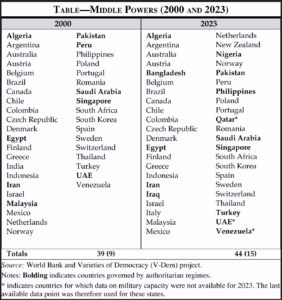
These figures point to a clear trend: Nondemocratic middle powers are becoming more prevalent. States that are either authoritarian or moving away from democratic politics now account for close to a third of all middle powers, compared with roughly a quarter in 2000. This represents a significant rebalancing of influence between democratic and nondemocratic middle powers. Just as important, authoritarian middle powers are now found across all major regions. While they have sometimes been described as “Southern” or “emerging” powers, neither label adequately captures the phenomenon. Authoritarian middle powers are not confined to the Global South — especially once autocratizing cases are included — and many were already firmly midsized a quarter-century ago. Rather than newly emergent actors, several have long exercised regional influence, consistent with established understandings of middle-power behavior. But the global wave of autocratization is amplifying their influence and impact.
Understanding the politics of authoritarian middle powers should therefore be a priority. Like their democratic counterparts, their conduct remains shaped by their midlevel material capabilities. But unlike countries such as Canada and Norway, this is increasingly filtered through authoritarian political logics. Above all, the foreign policy of authoritarian middle powers is driven by regime survival, with international engagement deployed to preempt external pressure, divert attention from domestic repression, and construct coalitions that help incumbents to retain power.
These survival-oriented strategies are not deployed in isolation, but rather through a variety of interconnected policies and approaches. Typical authoritarian middle powers combine coercive tools with softer forms of engagement, including diplomacy, mediation, and selective alliance-building, often within multilateral settings that provide political cover from external pressure. Hedging across overlapping networks — including those led by democratic states — allows regimes to diversify sources of support, reduce dependence on any single patron, and limit exposure to sanctions or isolation. The constraints of midsized power also heighten reliance on ideas, identity, and claims to legitimacy as instruments of international influence. We examine how these dynamics play out across three key domains: foreign policy and power projection, engagement with multilateral institutions, and efforts to legitimize authoritarian governance by reshaping norms and narratives. Taken together, these different dimensions reveal how authoritarian middle powers convert midsized capabilities into durable influence while systematically weakening democratic constraints at home and abroad.
Projecting Power, Protecting Authoritarian Rule
Foreign policy is typically understood as a means through which states pursue influence and security beyond their borders. For authoritarian middle powers, however, external engagement is shaped less by abstract strategic goals than by the imperative of regime survival. While they invest heavily in prestige diplomacy designed to position themselves as actors of international importance — often described as soft power — authoritarian middle powers have also shown a readiness to deploy coercive hard power when it serves domestic political ends. These strategies are not incidental. They are designed to deter external threats, preempt internal challenges, and reshape international environments in ways that reduce pressure for democratic reform.
Taken together, these efforts generate concrete benefits for regime stability. Transnational repression — including surveillance, intimidation, and the targeting of dissidents abroad — undermines the confidence and capacity of critical voices while preventing the consolidation of organized opposition, a pattern which Nate Schenkkan describes as a defining feature of a new “golden age” of authoritarian cross-border coercion.3 Securing regional dominance can bolster domestic support by fostering national pride, intimidating neighboring governments, and insulating regimes from future threats posed by rival states. Prestige diplomacy, for its part, can enhance a state’s international profile, increasing its influence within multilateral forums and bilateral relationships. Under favorable conditions, this influence can translate into greater access to resources and diplomatic cover for both domestic and international objectives, including tolerance of human-rights abuses and democratic backsliding.
Projecting military force abroad has long been recognized as a means of signaling resolve, influence, and power. For authoritarian middle powers, it also functions as a tool of internal control, demonstrating strength to domestic audiences while neutralizing perceived external and internal challengers. In recent years, states including Turkey, Saudi Arabia, Iran, and the UAE have deployed hard power in ways that increasingly resemble the strategies of larger powers. Turkey’s military interventions in Syria, for example, have weakened Kurdish groups regarded as threats to the regime, expanded Ankara’s regional influence, and enabled the forging of new alliances. Iran and Saudi Arabia, meanwhile, have engaged in proxy warfare in Yemen not only as part of an ideological rivalry, but to prevent the consolidation of regional dominance by a rival in a strategically important space.
What distinguishes authoritarian middle powers is not simply their willingness to use force, however, but the ambition and calculation behind it. Some states, such as Iran and Saudi Arabia, pursue overt regional hegemonic goals, while others — including Turkey and the UAE — seek to punch above their geographic and demographic weight. The Horn of Africa has emerged as a key arena for these ambitions.4 The UAE, in particular, has used military assistance, arms transfers, and security partnerships to extend its influence in Somalia and Sudan. In the former, it backed the government against al-Shabab. In the latter, it has fueled conflict through its support for the rebel paramilitary group Rapid Support Forces, which stands accused of crimes against humanity. These cases illustrate how military diplomacy and arms provision can create long-term political leverage, extending influence well beyond immediate neighborhoods.
Authoritarian middle powers have also innovated in the forms of hard power they deploy. Investment in domestic arms industries has become a means of enhancing international standing, while creating dependencies abroad. Turkey’s defense sector provides a clear example. Ankara has transformed itself into a significant arms exporter, particularly through its drone program. As a rising “drone power,”5 Turkey has reshaped battlefield dynamics in multiple conflicts, locked in security relationships with recipient states, and raised its international profile. Domestically, President Recep Tayyip Erdo¢gan has explicitly tied advances in defense production to national pride and regime competence, seeking to convert military innovation into political support.
These assertive strategies contrast sharply with the largely status quo–oriented regional approaches pursued by democratic middle powers in previous decades and more closely resemble the tactics associated with great powers. Such strategies are also inherently destabilizing. The decline of U.S. global hegemony, combined with the ability of authoritarian middle powers to offset the risks of crossing international red lines by cultivating ties with China and Russia, has reduced the costs of coercive behavior. This has further emboldened the use of hard power, even as it deepens regional instability and erodes democratic norms.
Authoritarian middle powers have therefore sought to offset coercion with softer forms of power that carry lower risks and reputational costs. Soft-power diplomacy is used to signal responsibility and international relevance, often mirroring the practices of democratic states. Prestige diplomacy and transactional development assistance have become central tools in this effort. High-profile mediation has been particularly important. States such as Qatar, Turkey, and Saudi Arabia have positioned themselves as indispensable intermediaries in regional and global conflicts. Qatar, for example, has leveraged its diverse network of relationships — including ties to the United States, Hamas, and a range of regional actors — to mediate conflicts from Gaza to Venezuela. Such efforts raise international standing while reinforcing an image of constructive global citizenship, even as domestic political space remains tightly controlled.
Other forms of prestige diplomacy focus on symbolic and cultural arenas. Sport has proven especially attractive. Qatar’s hosting of the 2022 World Cup and Azerbaijan’s staging of the 2015 European Games exemplify the use of mega-events to deflect attention from repression and rights abuses. Ownership of major sports teams, such as Emirati vice-president Sheikh Mansour’s investment in the Manchester City Football Club, serves a similar function, embedding authoritarian elites within globally admired institutions and normalizing their political authority.
Development assistance has also become an important tool of influence. Authoritarian middle powers deploy aid to cultivate a reputation for generosity while deepening political leverage over recipient states.6 Most notably, Saudi Arabia, the UAE, and Turkey have expanded their aid footprints precisely as Western engagement has receded. In addition, “emerging donors have stepped in to aid countries not serviced by the Western-led aid community.”7 Unlike Western donors, these emerging donors rarely attach conditions related to democratic reform or human rights, which makes them attractive partners for autocratic and autocratizing regimes. The result is a parallel aid ecosystem that sustains authoritarian governance and weakens democratic conditionality. In Sheikh Hasina’s increasingly authoritarian Bangladesh, for instance, reductions in Western assistance, in part linked to democratic concerns, were offset by increased support from authoritarian and autocratizing donors — most notably India, but also China, Saudi Arabia, and the UAE — enabling her government to maintain capacity without meaningful reform.
The combined use of hard and soft power highlights the breadth and flexibility of authoritarian middle-power foreign policy. It also exposes its contradictions. States that portray themselves as peace brokers while fueling proxy conflicts, or as generous donors while repressing dissent, operate within a strategy of deliberate ambiguity. Hedging is central to this approach: Authoritarian middle powers seek influence while minimizing exposure to retaliation.
Yet this ambiguity carries risks. As ambitions expand, so too does the potential for miscalculation. While authoritarian middle powers have developed innovative ways to project influence, they remain vulnerable to the volatility they help to generate. Overestimating the protection afforded by alliances or misjudging the tolerance of major powers can trigger instability or escalation. Moreover, their calculated use of hard and soft power — working simultaneously within and against the liberal international order — contributes to a more unstable international environment, particularly in the regions closest to their reach.
Working Within and Against the Rules-Based Order
Democratic middle powers have long been cast as guardians of multilateralism and liberal internationalism. Contrary to widespread assumptions, however, their nondemocratic counterparts have neither ignored nor rejected multilateralism. What is distinctive is the way they engage strategically to advance regime survival and blunt democratic pressure. In global organizations such as the United Nations, middle powers have worked to dilute liberal commitments by reshaping agendas, language, and voting coalitions. Such states have also used regional organizations, old and new, to advance authoritarian counternorms and counterpractices.8 Formal multilateralism is not the only arena in which this occurs. Authoritarian middle powers also operate through less formal networks and ad hoc coalitions among states with shared interests. What emerges is a sophisticated strategy of authoritarian multilateralism — one that seeks not to dismantle international institutions, but to make them safer for authoritarian rule by reshaping them from within.
This strategy is particularly visible in coordinated voting and sponsorship patterns at the United Nations. Counties such as Egypt, Pakistan, Saudi Arabia, the UAE, and Indonesia have repeatedly worked together in the UN General Assembly and the UN Human Rights Council (UNHRC) to block country-specific scrutiny, weaken investigative mandates, and dilute resolutions addressing democratic erosion. Rather than rejecting human-rights language outright, these states have focused on procedural obstruction and textual revision, substituting references to democracy and civil and political rights with appeals to dialogue, technical cooperation, and national ownership. Acting collectively, they have been able to exert influence disproportionate to their individual power, reshaping outcomes through coalition-building rather than vetoes.
Recent empirical evidence underscores the cumulative impact of these practices. Using systematic text analysis of UN resolutions and debates, Jennie Barker shows that references to democracy and political rights have declined across key forums such as the General Assembly, while language emphasizing sovereignty, development, and noninterference has become more prominent.9 These shifts are not driven solely by authoritarian great powers. Instead, they reflect the sustained efforts of voting coalitions in which authoritarian middle powers play a central coordinating role. Over time, this incremental recalibration has reduced the visibility and salience of democracy within the UN system itself, weakening a key normative environment in which democratic accountability is meant to operate.
Important multilateral bodies, most notably the UNHRC, have therefore become sites of sustained contestation in which authoritarian middle powers coordinate to weaken democratic scrutiny.10 Spearheaded by China and Russia but actively supported by states such as Egypt and Venezuela, these efforts have recast human rights through a developmental and sovereignty-first lens. The shift away from civil and political rights toward the “right to development” blunts external criticism while legitimizing repressive domestic practices.11
The Like-Minded Group (LMG), a loosely coordinated bloc of nearly thirty states, has notably played a central role in advancing claims of civilizational pluralism. Comprising core authoritarian and autocratizing powers — including Indonesia, Egypt, and Venezuela — the LMG has worked to resist democratic oversight at the UN by emphasizing noninterference, cultural relativism, and the primacy of state sovereignty. A 2014 Egyptian statement illustrates this approach, calling for respect for sovereignty alongside a greater focus on the “right to development.”12 While recognition of global diversity corrects Western dominance, these claims have also been used to delegitimize scrutiny and insulate governments from accountability for democratic backsliding and rights abuses.
While global institutions remain important, regional arenas often provide greater room to maneuver. Across Latin America, Southeast Asia, and Central Asia, authoritarian middle powers have promoted what has been termed “authoritarian regionalism”:13 the creation and manipulation of regional bodies to legitimize autocracy and facilitate regime survival. These organizations provide financial and diplomatic support to friendly regimes, coordinate repressive practices such as surveillance and extradition, and enshrine authoritarian norms through public endorsement.14 The Association of Southeast Asian Nations (ASEAN) illustrates this dynamic. Beyond economic integration, ASEAN has served as a platform through which authoritarian middle powers resist democratic openings and, at times, facilitate cross-border repression.
To secure these advantages, leaders have gone beyond subverting existing bodies and have revitalized moribund organizations or created new ones. The Organization of Turkic States (OTS) and the Bolivarian Alliance for the Peoples of Our America (ALBA) exemplify this trend.15 Established by Cuba and Venezuela — and later joined by Bolivia, Ecuador (until 2018), and Nicaragua — ALBA was explicitly intended as an alternative to institutions such as the Organization of American States (OAS), viewed as U.S.-dominated, overly critical of authoritarian practices, or insufficiently aligned with anti-imperial and socialist goals.
Another telling example is the Gulf Cooperation Council (GCC), established in 1981 by Arab Gulf monarchies in the wake of the Iranian revolution and regional tensions. Since then, the GCC has evolved into a platform for military and political cooperation, including mutual support in managing domestic opposition — notably contributing to the suppression of popular protest in Bahrain in 2011. The GCC has also evolved into a platform through which member states coordinate activities and narratives to buffer themselves against external pressures from great powers.
In this way, authoritarian regional bodies function as both strategically useful alternatives to their democratic counterparts and insurance mechanisms against pressure to democratize. Unsurprisingly, the number of authoritarian-dominated regional organizations has grown and now outnumbers democratic regional bodies.16 In doing so, they have become key vectors through which authoritarian middle powers cultivate regions that tolerate, and sometimes actively endorse, their politics.
Authoritarian internationalism also extends beyond formal institutions. Increasingly, middle powers build looser networks and minilaterals around infrastructure, security, or trade in order to sidestep normative scrutiny. Turkey’s promotion of the Trans-Caspian International Transport Route — the Middle Corridor — illustrates this approach. Linking Turkey to Central Asia and China, the initiative enhances Ankara’s leverage while reducing dependence on Western partners and projecting entrepreneurial competence.
Yet authoritarian middle powers rarely abandon engagement with democratic states or institutions. Most are omnibalancers, hedging across blocs to preserve autonomy and minimize risk. While Iran and Venezuela have pursued more confrontational strategies, they remain exceptions, and their recent experiences demonstrate the risks of this approach. More commonly, authoritarian middle powers maintain ties to democratic powers and ostensibly prodemocratic institutions. Turkey’s ambivalence toward Europe and the West exemplifies this pattern: strong enough to deploy antagonism strategically, such as delaying Sweden’s accession to NATO, but insufficiently powerful to jeopardize core economic and security relationships, particularly with the West.
The rise of authoritarian middle powers poses a profound challenge to liberal institutions. By weaponizing multilateralism, these governments transform forums designed to uphold democratic norms into instruments of regime legitimation. At the regional level, the proliferation of authoritarian organizations has dampened prospects for political liberalization among member states.17 This internationalism is fragmented and opportunistic, yet increasingly effective. By coopting institutions, creating parallel bodies, and assembling ad hoc coalitions, authoritarian middle powers work simultaneously within and against the rules-based order, reshaping it in ways that narrow the space for liberal values and democratic accountability.
Legitimizing Authoritarian Governance
Authoritarian middle powers are also adept at using political ideas and ideologies to tout their regime’s performance, manufacture legitimacy, and manage their global reputation, allowing them to shape how they are perceived both domestically and internationally. For the leaders of authoritarian middle powers, these tools are key to sanitizing their image and reshaping international norms in ways that favor the nondemocratic values underpinning their rule. In some cases, those political ideas and ideologies reflect leaders’ core beliefs — for example, when they appeal to religious identity to build ties with likeminded states and publics. More often, however, narratives are carefully crafted and projected abroad to serve strategic ends, above all regime survival. Whether framed as technocratic and apolitical or grounded in more explicit worldviews such as traditionalism, these efforts are frequently antidemocratic in effect and are reshaping global norms.
Nation-branding plays a key role in this process by managing how regimes are seen internationally.18 Projected outward, nation-branding can make “achieving foreign policy goals easier and helps marginalise foreign critics. It also makes it tougher for exiles and domestic activists to work together.”19 Unlike liberal democracies, whose branding typically invokes democratic values — often selectively — authoritarian middle powers emphasize service delivery, economic performance, and political stability. When linked to global benchmarks such as the UN Sustainable Development Goals, such narratives can position authoritarian regimes as models to emulate. Ethiopia, a borderline middle power but the third-largest economy in sub-Saharan Africa, successfully marketed its poverty-reduction and reform agenda under Prime Minister Meles Zenawi (1995–2012), securing donor support despite electoral manipulation and human-rights abuses.20 Appeals to regional stability reinforced this narrative, helping to justify continued international backing. Similar logics are evident in Saudi Arabia’s Vision 2030, which recasts authoritarian governance as technocratic and reformist, aiming to soften international criticism while political repression continues.
Other branding strategies rely more heavily on ideological imagery. Prior to Maduro’s removal by the United States, Venezuela offered a prominent example. Its leaders consistently portrayed the country as a symbol of global resistance, justifying authoritarian policies through appeals to domestic equality and Southern solidarity. This anti-imperialist framing has helped to bind new international alliances, including within the BRICS grouping of emerging economies — now expanded to include Ethiopia, Iran, Saudi Arabia, and the UAE, all authoritarian.
In contrast, Gulf states have largely pursued ostensibly apolitical branding. The UAE provides the clearest case, deploying logos, websites, and press kits that emphasize diversity, happiness, and generosity. These narratives bolster its economic reputation while also helping to “crowd-out, delegitimize and ultimately deter political dissidents.”21 Comparable dynamics can be seen in Turkey’s global export of historical television dramas, which promote conservative nationalism and strong leadership while reinforcing civilizational narratives aligned with the government’s domestic political project.
The appeal of nation-branding is unlikely to fade. Though costly, it allows authoritarian leaders to humanize and legitimize regimes that are often corrupt or repressive. By emphasizing development and stability, they present themselves as effective and progressive, contributing to the global normalization of authoritarian practices. As ideas about “effective” or “well-performing” authoritarianism gain traction, such narratives make authoritarian rule appear both viable and desirable, while obscuring its coercive foundations.
Authoritarian middle powers also deploy ideas and ideologies more directly to contest democratic norms. Two strands have been especially influential. The first emphasizes civilizational plurality, challenging universal claims associated with democracy and human rights. The second promotes traditional or conservative values. Together, these narratives are used to justify repression and resist international scrutiny.22
While China has been central to advancing civilizational arguments, including through its Global Civilization Initiative (GCI), similar language has been adopted elsewhere. Venezuelan leaders have previously called for alternatives to “barbaric capitalism” and external political conditionality, while a number of other middle powers including Egypt, Pakistan, and the UAE have used language consistent with China’s GCI. Although the recognition of global diversity is an important corrective to the historical dominance of Western ideas, this ideology has also been used to delegitimize external scrutiny and insulate authoritarian governments from accountability for democratic backsliding and rights abuses. These ideological salvos also come in more populist versions, as in Poland under the Law and Justice Party, where socially conservative rhetoric accompanied restrictions on media freedom and civil society, and a backlash against women’s and LGBTQ+ rights.
A second strategy has focused instead on identity, emphasizing shared religion or ethnicity to build loyalty at home and solidarity abroad. Iran provides the most far-reaching example. Drawing on Shia Islam and the legacy of the 1979 revolution, the ideology of the Islamic Republic blends self-sufficiency with anti-Westernism, presenting the regime as a defender of Muslims worldwide. Cultural diplomacy — through education, film, and sport — supports this projection and complements military and financial interventions, including backing for Hezbollah. Elsewhere, states such as Saudi Arabia and Indonesia have used religion more softly to enhance regional influence. Indonesia’s promotion of “moderate Islam” and Islamic diplomacy illustrates how identity can be mobilized without overt confrontation.23
The projection of ideas, ideologies, and identities by authoritarian middle powers serves dual purposes. Domestically, it resonates with citizens drawn to identity-based narratives, reinforcing regime legitimacy. Internationally, it builds external support and shapes how authoritarian regimes are understood globally. While much attention focuses on China and Russia, the influence of authoritarian middle powers often travels farther than expected, in part because their apparent success feels more attainable to many states in the Global South than that of great powers. Consequently, as the pro-authoritarian narratives of states such as Turkey and the UAE circulate, they weaken the appeal of democratic norms and help recast authoritarianism as a legitimate — sometimes even attractive — alternative.
Public-opinion data demonstrate why such narratives are so damaging. Across regions, satisfaction with democracy is falling while tolerance for nondemocratic alternatives has grown.24 These trends are driven by a number of factors, including democracy’s own shortcomings, but they are reinforced by the efforts of authoritarian middle powers to normalize repression and present authoritarian governance as effective and legitimate, making it harder for democratic values to thrive.
Middle Powers and the Authoritarian Turn
As the liberal rules-based international order enters a period of profound crisis, it cannot be assumed that middle powers will act collectively to defend it. On the contrary, authoritarian midsized states have been central to the erosion of the liberal rules-based order, pushing international red lines, facilitating cross-border repression, weakening multilateral commitments to human rights, and normalizing authoritarian governance. Rather than withdrawing from international institutions, authoritarian middle powers have remained deeply engaged, using them selectively to reshape rules and norms in ways that protect regime interests, including by elevating principles such as sovereignty and noninterference and by exploiting regional organizations and informal forums to shield allies from scrutiny.
Taken together, these practices have gradually hollowed out the norms and institutional commitments that have sustained rules-based, democracy-supporting multilateralism. As authoritarian forms of power become more entrenched internationally, the political and normative costs of illiberal behavior continue to fall, creating greater scope for authoritarian middle powers to pursue these strategies with confidence. This, in turn, will make it increasingly difficult for democratic middle-power governments, such as Canada and its like-minded allies, to forge common ground with their nondemocratic counterparts to prevent the collapse of the rules-based order.
To date, the distinctive impact of authoritarian middle powers has often been underestimated due to an — often unspoken — assumption that they are effectively proxies of other states. Yet, while they often align with authoritarian great powers, particularly within forums such as the UN General Assembly and UNHRC, it would be a mistake to view authoritarian middle powers simply as extensions of China and Russia. In reality, these midsized countries retain considerable autonomy and pursue strategies that at times diverge from the preferences of Beijing or Moscow. Indeed, their preference for hedging and maintaining relationships across competing blocs means that they rarely bind themselves fully to any single patron or alliance. Despite having close ties with Moscow, for example, President Erdo¢gan has repeatedly supported Azerbaijan militarily against Armenia, supplying Azerbaijan with drones and military advisors. These moves effectively challenge Russia’s role as the primary security arbiter in the South Caucasus, weakening Moscow’s leverage over a region it views as part of its privileged sphere of influence.
This strategic ambivalence and independence points to another important conclusion. The foreign policies of authoritarian middle powers are likely to remain pragmatic and fragmented. Cooperation will coexist with rivalry, producing fluid alignments and persistent uncertainty. Conflicts such as the war in Yemen, which by proxy has pitted Iran against Saudi Arabia, and the UAE’s involvement in Sudan illustrate how these dynamics unfold in practice. The future may well be more authoritarian, but the challenge posed by authoritarian middle powers is unlikely to take the form of a coherent or coordinated assault on the liberal international order. Instead, it will be uneven, unpredictable, and deeply shaped by the incentives of middle-power politics — making it harder to anticipate, and more difficult for democracies to counter.

NOTES
1.Matías Bianchi, Nic Cheeseman, and Jennifer Cyr, “The Myth of Democratic Resilience,” Journal of Democracy 36 (July 2025): 33–46.
2.George de T. Glazebrook, “The Middle-Powers in the United Nations System,” International Organization 1, no. 2 (1947): 307–15.
3.Nate Schenkkan, “The Golden Age of Transnational Repression,” Journal of Democracy 36 (October 2025): 36–50.
4.Harry Verhoeven, “The Gulf and the Horn: Changing Geographies of Security Interdependence and Competing Visions of Regional Order,” Civil Wars 20, no. 3 (2018): 333–57.
5.Ash Rossiter and Brendon J. Cannon, “Turkey’s Rise as a Drone Power: Trial by Fire,” Defense and Security Analysis 38, no. 2 (2022): 210–29.
6.Samiratou Dipama and Emel Parlar, “Assessing Turkey–Africa Engagements,” APRI Policy Brief no. 2/2023 (Berlin, 2023); Yasmine Farouk, “Saudi Arabia: Aid as a Primary Foreign Policy Tool,” Carnegie Endowment for International Peace, 9 June 2020, https://carnegieendowment.org/2020/06/09/saudi-arabia-aid-as-primary-foreign-policy-tool-pub-82003.
7.Alexander Cooley, “Authoritarianism Goes Global: Countering Democratic Norms,” Journal of Democracy 26 (July 2015): 49–63, 59.
8.Cooley, “Authoritarianism Goes Global,” 49.
9.Jennie Barker, “The Changing Geopolitical Landscape for Support for Democracy,” American Political Science Association Convention, 6 September 2024.
10.Tom Ginsburg, “How Authoritarians Use International Law,” Journal of Democracy 31 (October 2020): 44–58.
11.Ted Piccone, “China’s Long Game on Human Rights at the United Nations,” Brookings Institution (September 2018), 4, https://www.brookings.edu/articles/chinas-long-game-on-human-rights-at-the-united-nations/.
12.Rana Siu Inboden, “Authoritarian States: Blocking Civil Society Participation in the United Nations,” Robert Strauss Center for International Security and Law, University of Texas at Austin (February 2019), 4.
13.Alexander Libman and Anastassia V. Obydenkova, “Understanding Authoritarian Regionalism,” Journal of Democracy 29 (October 2018): 151–65.
14.Christina Cottiero and Stephan Haggard, “Stabilizing Authoritarian Rule: The Role of International Organizations,” International Studies Quarterly 67, no. 2 (2023).
15.Marianne Kneuer et al., “Playing the Regional Card: Why and How Authoritarian Gravity Centres Exploit Regional Organisations,” Third World Quarterly 40, no. 3 (2019): 451–70.
16.Cottiero and Haggard, “Stabilizing Authoritarian Rule,” 2.
17.Cottiero and Haggard, “Stabilizing Authoritarian Rule,” 12.
18.Petra Alderman, Branding Authoritarian Nations: Political Legitimation and Strategic National Myths in Military-Ruled Thailand (London: Routledge, 2023).
19.Alexander Dukalskis, “How Authoritarian Rulers Manage Their International Image,” The Conversation, 31 August 2021, https://theconversation.com/how-authoritarian-rulers-manage-their-international-image-166778.
20.Stephen Brown and Jonathan Fisher, “Aid Donors, Democracy, and the Developmental State in Ethiopia,” Democratization 27, no. 2 (2020): 185–203.
21.Robert Uniacke, “Authoritarianism in the Information Age,” British Journal of Middle Eastern Studies 48, no. 5 (2021): 979–99.
22.Thomas Ambrosio, “Catching the ‘Shanghai Spirit,’” Europe-Asia Studies 60, no. 8 (2008): 1321–44.
23. Amanda tho Seeth, « La diplomatie islamique de la paix en Indonésie », GIGA Focus Asia, n° 2 (2023), https://www.giga-hamburg.de/en/publications/giga-focus/indonesia-s-islamic-peace-diplomacy-crafting-role-model-for-moderate-islam.
24. Afrobarometer, « African Insights 2025 : Rapport phare », Afrobarometer, https://www.afrobarometer.org/wp-content/uploads/2025/05/Citizen-engagement-Afrobarometer-flagship-report-ENG-4july25.pdf ; Pew Research Center, « La démocratie représentative reste un idéal populaire », 28 février 2024, https://www.pewresearch.org/global/2024/02/28/representative-democracy-remains-a-popular-ideal-but-people-around-the-world-are-critical-of-how-its-working/.
Copyright © 2026 National Endowment for Democracy et Johns Hopkins University Press
Crédit image : Mikhaïl Svetlov/Getty Images
